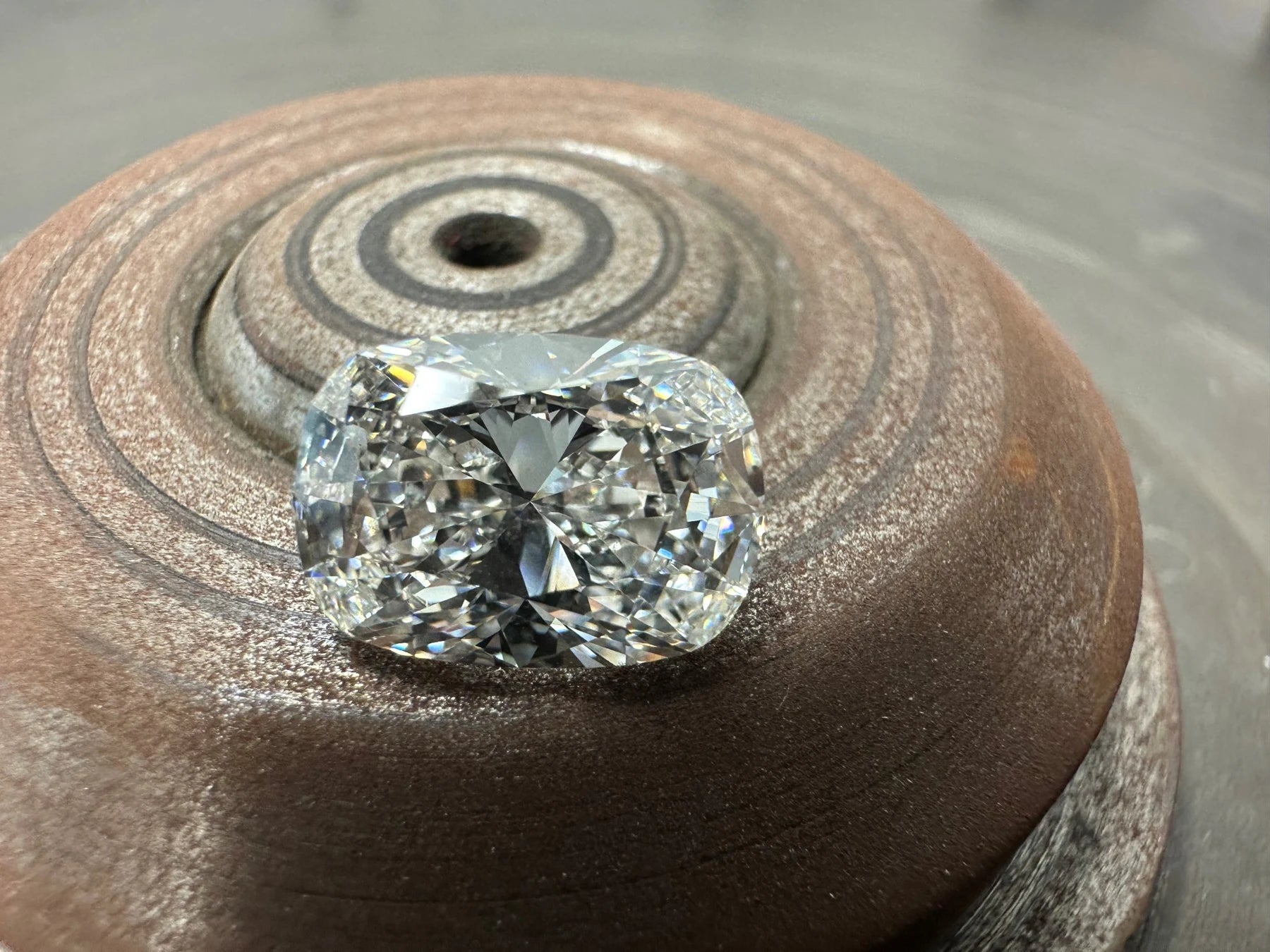
Understanding a diamond makes choosing one more personal. Start with the cushion shape, discover the differences in faceting, and learn what to look for beyond the grading report.
01 / START WITH THE SHAPE
What is a cushion cut?
A cushion is a square or rectangular diamond outline with curved sides and softened corners. It takes its name from that familiar pillow-like form.
The modern cushion has roots in the old mine cut, an earlier style with a higher crown, smaller table, and a more visible culet. Today’s cushions encompass a wide range of outlines and facet designs.
Think of shape as the outline you see from above, and faceting as the arrangement of polished surfaces that interacts with light. Two diamonds can share a cushion outline and look strikingly different.
Why can two cushions look so different?
The outline, crown and pavilion proportions, facet layout, and alignment work together. Those choices change the reflections you see face-up: their size, contrast, arrangement, and movement. A broad flash and a field of tiny flashes can both come from a cushion-shaped diamond.
A closer look at a cushion’s softly curved outline and visible facet pattern.
02 / UNDERSTAND THE FACETS
Cushion brilliant. Cushion modified brilliant.
These names describe cutting styles within the cushion family. They are not, by themselves, quality grades.
A cushion brilliant commonly has four or eight main pavilion facets. A cushion modified brilliant incorporates additional facets on the crown or pavilion. The resulting appearance depends on the complete arrangement and proportions.
Comparing cushion cutting styles
Style
What to explore
Cushion brilliant
Defined facet patterns and the character of its broader flashes. Compare the actual stone in motion.
Cushion modified brilliant
The effect of the additional facets. Some show a more fragmented sparkle often described as “crushed ice”; appearances vary.
What does “true cushion brilliant” mean? It is a descriptive phrase you may encounter in the trade. Ask which facet arrangement is meant and read the individual grading report. Likewise, “8-main” describes a facet configuration—not an automatic quality rating.
Our preference is for a clear, lively pattern of light. Your preference may be different. Compare stones under the same lighting and let the visual differences guide the conversation.
Two examples from our imagery. Lighting, angle, and the individual diamond affect appearance; this is not a controlled performance comparison.
03 / COUNT THE MAINS, THEN LOOK DEEPER
Traditional 8-main. Signature 10-main.
The number of pavilion mains describes part of the diamond’s facet architecture. It does not tell the whole story of its appearance.
The traditional 8-main cushion brilliant
“Eight-main” refers to eight principal facets on the pavilion, the lower part of the diamond. This arrangement is often associated with a defined brilliant-style pattern and broad flashes. The exact result still depends on the full geometry and execution of the cut.
Eight mains do not automatically mean eight hearts and arrows. A facet count and a demonstrated optical pattern are different descriptions.
The Zahra 10-main H&A Cushion
The Zahra is specific to Cushion Brilliant: our exclusive, custom-developed lab-grown cushion brilliant, designed by Troy Lob in collaboration with a diamond cutter overseas. It features ten pavilion main facets and is designed to reveal ten hearts and ten arrows through an appropriate viewer.
Its square, softly rounded outline and defined brilliant-style appearance express Troy’s personal vision for a cushion. The intention is exceptional beauty, optical symmetry, and light performance, rather than a promise based on facet count alone.
Antique and modern cushions can speak very different visual languages.
Old mine and antique-style cushions
Historical old mine cuts commonly have a high crown, small table, deep pavilion, and a visible culet—the small facet at the bottom of the diamond. Their larger-looking flashes and distinctive patterns are part of their appeal.
A newly cut diamond may be inspired by this aesthetic. “Antique-style” describes its design; it does not establish the stone’s age.
Chunky and crushed-ice appearances
“Chunky” is an informal way to describe broad, readily distinguishable flashes. “Crushed ice” describes a more splintered or fragmented pattern of sparkle. These are visual descriptions, rather than laboratory quality grades.
Neither term captures every possible cushion. A modern brilliant can have bold flashes, and modified designs can show a range of appearances. Look at the stone in motion to understand its individual character.
Choose the personality you enjoy. Ask to compare a broad-flash cushion with a more fragmented pattern in the same lighting. Notice which one holds your attention as it moves.
05 / FIND YOUR OUTLINE
Square or elongated?
A square cushion feels balanced. An elongated cushion has a longer rectangular outline. Neither outline is inherently a better cut.
Length-to-width ratio describes this relationship: divide the longer measurement by the shorter one. A diamond measuring 8.0 × 6.0 mm has a ratio of about 1.33. A ratio closer to 1.00 looks more square.
Also look at the curve of the sides, the corners, and how the outline works in a setting. Two cushions with the same ratio can still feel quite different.
Ask to compare: length and width in millimeters, face-up photographs at the same scale, and views on a hand or beside a setting.
Illustration of outline only. The width is held constant on screen; this does not predict carat weight, actual dimensions, or light performance.
06 / WATCH THE LIGHT
Brilliance is more than a bright photograph.
A diamond’s appearance changes as the light, the stone, or the viewer moves. Three useful ideas help describe what you see.
Brightness
The white light returned to your eye. Notice whether the diamond looks lively across its face rather than bright in only one area.
Fire
The flashes of spectral color. These can become especially noticeable under smaller, more concentrated light sources.
Scintillation
The changing sparkle and pattern of bright and dark areas with movement. Contrast is part of that pattern; a still photograph captures only a moment.
What about hearts and arrows?
A dedicated viewer reveals reflections that make optical symmetry easier to examine. Hearts are generally assessed looking toward the pavilion; arrows are assessed face-up through the crown. They are different views of the diamond, not two patterns visible at once to the unaided eye.
Optical symmetry concerns the relationships among facet reflections. It is distinct from a laboratory’s external symmetry assessment. Consider viewer images together with brightness, fire, contrast, and appearance in ordinary lighting.
The Zahra distinction: our exclusive lab-grown cushion uses ten pavilion mains and a ten-heart, ten-arrow optical design. Ask for viewer images of the actual diamond, as well as video and its report.
Try this: compare a diamond in diffused daylight, softer indoor light, and spot lighting. Look at it face-up and while gently moving it.
07 / PUT THE 4Cs IN CONTEXT
Four factors. One individual diamond.
Cut, color, clarity, and carat weight give you a framework for comparison. Your priorities determine the balance.
Cut
How the diamond’s proportions, facet arrangement, and craftsmanship work together. For cushions, evaluate the actual appearance as well as the available measurements and assessments.
Color
The presence or relative absence of body color. Compare stones in similar lighting and consider the metal color of your intended setting.
Clarity
Internal inclusions and surface features. Their size, position, and visibility matter. Ask what can be seen without magnification and whether any feature raises a durability concern.
Carat weight
A measure of weight, not face-up size. One carat equals 0.2 grams. Compare millimeter dimensions as well as weight to understand the visible presence of a cushion.
There is no single combination that suits everyone. Use your budget and visual preferences to decide which differences are meaningful to you.
08 / READ THE REPORT
Know what a grade actually describes.
A grading report documents the diamond examined by that laboratory. It should support your inspection, not replace it.
GIA and cushion cut grades
GIA currently does not assign an overall cut grade to cushion diamonds. Its overall cut grading system applies to standard round brilliant diamonds in the D-to-Z color range. “Excellent” polish and symmetry on a cushion report describe finish and alignment; they are not an overall cushion cut grade.
GCAL and light-performance assessment
GCAL offers an 8X assessment for cushions that considers polish, external symmetry, proportions, brilliance, fire, scintillation, optical symmetry, and shape aesthetics. Review the actual certificate to see which assessments apply to the diamond in question.
Check the individual stone. Laboratories and report types differ. A brand name, a photograph, or a description of a cut does not mean that every diamond has the same report or certification.
Ask for the report number, confirm it with the issuing laboratory’s verification service, and compare its measurements and identifying details with the stone you are considering. Ask the jeweler to explain any comments or unfamiliar terms.
09 / UNDERSTAND ORIGIN
Natural and laboratory-grown diamonds.
Both are diamonds. Their origins are different.
Natural diamonds form in the earth. Laboratory-grown diamonds are produced through technological processes such as high pressure, high temperature (HPHT) or chemical vapor deposition (CVD). They have essentially the same chemical, physical, and optical properties as natural diamonds; specialized testing can distinguish their origin.
Laboratory-grown diamonds are different from diamond simulants, such as cubic zirconia or moissanite. Ask for clear identification of origin and any treatments, and review the applicable laboratory document.
Choose with a clear understanding of what you are buying. Discuss the individual stone, your preferences, and its current price rather than assuming that origin alone predicts its beauty.
10 / MAKE IT PERSONAL
Your cushion comparison checklist.
A few thoughtful questions make a diamond conversation much more useful.
Do I prefer a square or elongated outline?
Which facet pattern and style of sparkle appeal to me?
Have I seen the actual diamond in motion and in more than one light?
How do the millimeter dimensions compare with other stones?
What does its report say—and what does it leave ungraded?
Are its origin and any treatments clearly disclosed?
How will the diamond work with the setting I have in mind?
Have we confirmed the total price, timing, and applicable store policies?
Is every cushion modified brilliant a “crushed ice” diamond?
No single informal description captures every diamond in this broad category. Modified refers to additional facets. Examine the individual pattern and appearance rather than relying on the label alone.
Does an 8-main cushion automatically have better light performance?
No. The main-facet configuration is part of a cutting style. Proportions, craftsmanship, and the complete facet arrangement also affect how the stone looks.
Is there one ideal table or depth percentage for every cushion?
Cushions have varied outlines and facet arrangements, so a universal pair of percentages cannot describe all of their visual differences. Consider the full report, available performance analysis, and the actual diamond.
Will a higher carat weight always look larger?
Not necessarily. Carat is weight. Face-up dimensions and the distribution of that weight influence how much of the diamond you see from above.
Can I choose a diamond from a photograph alone?
A photograph is helpful, but lighting, angle, and magnification affect what it shows. Ask for video, the grading report, and a guided comparison or an opportunity to view the stone.